Commercial Solar 101: Solar for Your Business in Northern Colorado
Are commercial solar panels worth it?
It depends on the specifics of your energy consumption profile, your utility provider, and several other factors, but often the answer is yes. If you find yourself paying a lot on your monthly electricity bill, then there’s a good chance that solar (potentially combined with battery storage) can help reduce that monthly cost. Additionally, if you have a large, flat roof or a large open area of land, there is a good chance that solar is worth it for your operation.
How Commercial Solar Works
- If you’re a small to medium business, most of the cost of your electric bill is determined by each incremental unit (kWh) of electricity that you use.
- If you’re a large energy consumer, most of the cost of your electric bill is determined by your peak demand (kW) during the handful of times during the month when you use the most electricity.
This can be counterintuitive, as a business can theoretically only use a little electricity overall, but if it requires a significant “peak” electricity flow at a single point in time, it may still see large electric bills.
The Lifespan of a Commercial Solar Panel System
An industry standard for the lifespan of a commercial solar system is approximately 25 years. Many factors may influence this lifespan, such as rooftop condition, business operations, and location. The solar panels themselves retain around 80 to 90 percent efficiency after 25 years. Inverters, the device that changes energy from Direct Current (DC) to Alternating Current (AC), often have a 10 to 15-year lifespan; while replacement may not be necessary, to keep systems operating at full efficiency, it is recommended to expect an inverter replacement around year 15. Alternatively, Sandbox+ Solar offers maintenance and monitoring plans to ensure our experts are keeping an eye on your system, guaranteeing self-sufficiency for your system’s lifetime.
Determining Your Business's Solar Power Needs
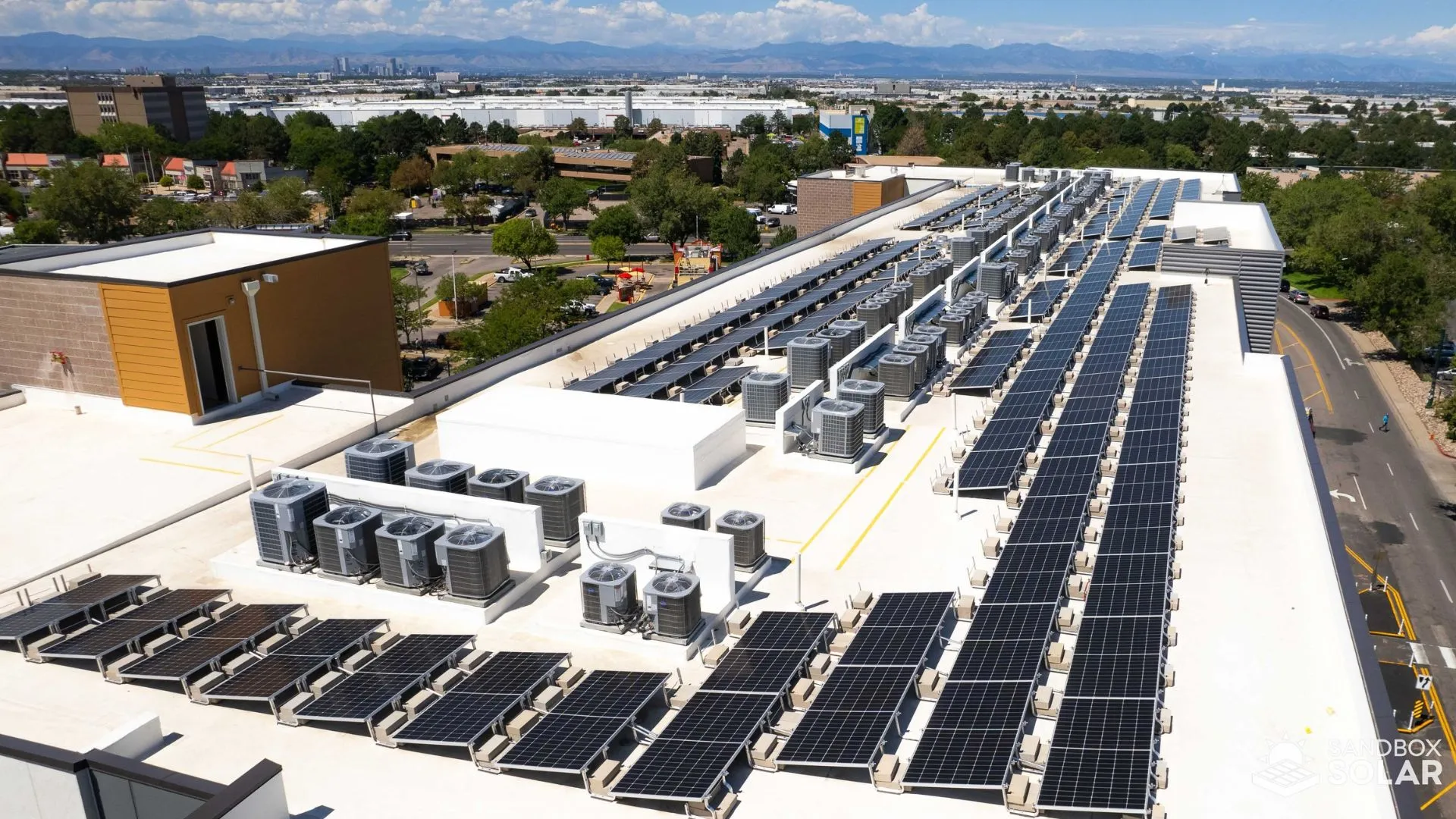
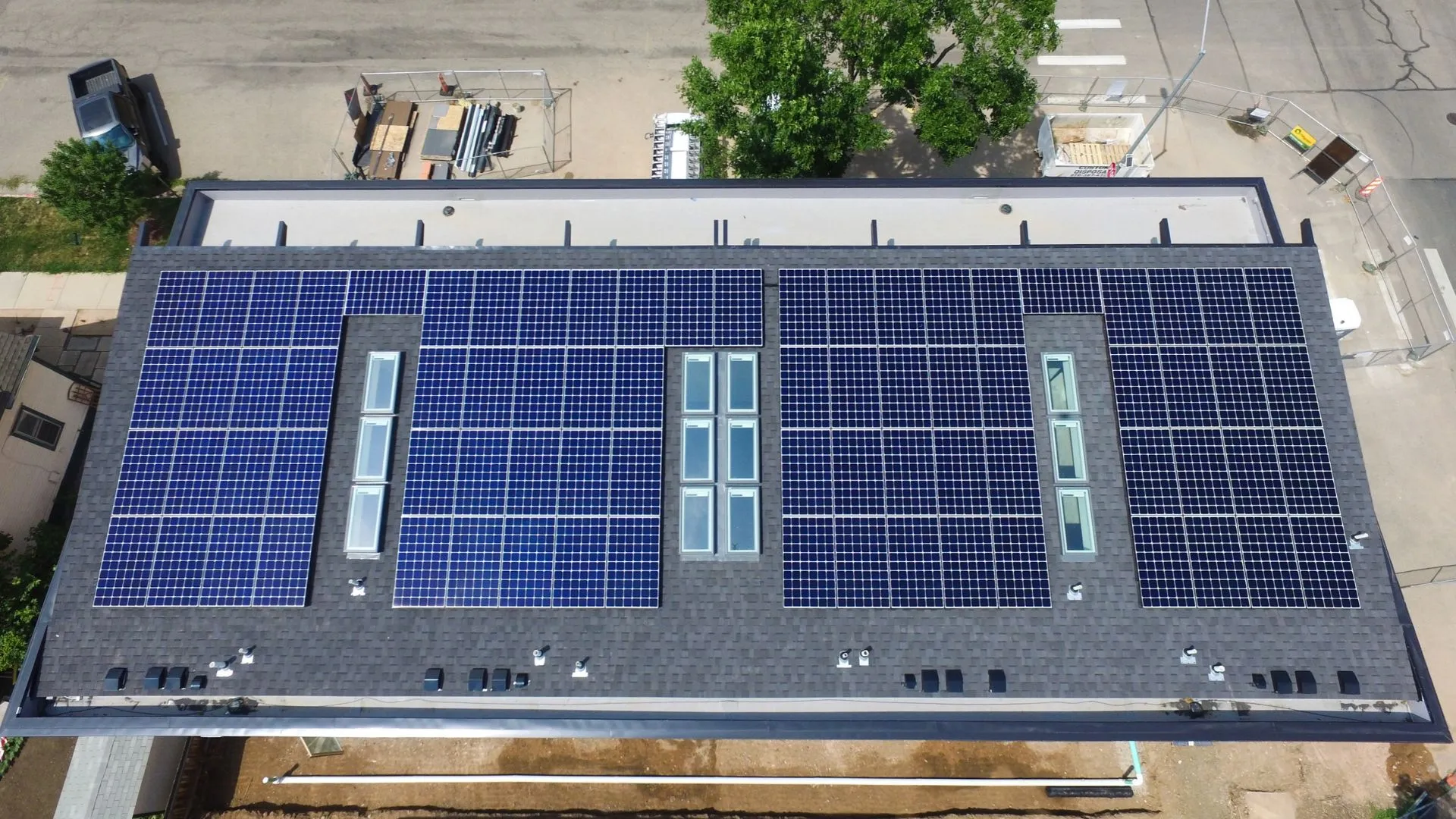
Depending on the size of your business and how much energy you need to power your daily operations, this will determine how many solar panels your commercial building needs. For example, a hole-in-the-wall ice cream shop will have a vastly different energy consumption compared to massive buildings like data centers, hotels, or airports.
Smaller projects that land somewhere around 30kW DC are roughly about 45 to 50 panels, whereas a project that is 1.4MW DC would be roughly 2,300 panels. Since panels come in all different wattage sizes, the actual number can vary, but typically for commercial use, the standard panel wattage range is anywhere from 530w to 590w.
What is the best solar system for commercial use?
That being said, either approach has potential to be a good option. We would be able to determine that on a case-by-case basis. Most commercial properties have a flat roof, which means that a ballasted system is the standard approach. There are other properties that have sloped roofs, which would determine the type of racking needed, but that would also be determined on a case by case situation.
What to Know About Requesting Information
When you reach out to our team to get more information about your commercial solar project, there are some things you should know to be prepared to discuss with our sales team. Many things come into play when it comes to larger-scale solar projects for a business. Most of these projects are not as straightforward as a residential solar project. Here are some key things to pass off to our team that help with the process:
- Our team wants to understand your goals and why you are interested in investing in a solar array for your property.
- Where is your array going to be located? What type of roofing do you have? This is important for our team to design a system accurately that will meet your energy goals.
- Having your utility voltage handy, typically 120/208V 3-phase or 277/480V 3-phase for commercial buildings, allows our engineers to verify system compatibility and interconnection requirements.
- Sending us copies of your utility bills (12 months are preferred) can help us accurately quote the system size you need to offset your energy production.
- Sharing your physical property address along with your preferred point of interconnection (POI) helps our team immediately assess roof space, solar irradiance, and grid-tie logistics.
- Providing existing as-built, structural, and electrical plans gives us the data needed to evaluate your building’s load-bearing and electrical capacity.
Our Process at Sandbox+
The process will start with a discovery call, site visit, rough design and ROM, internal review, and final proposal. If awarded the project, it will go through the contracting phase for redlines and final contract approval, then move to pre-construction, where the procurement and final design, stamped drawings, and permitting will take place. Once all that is complete, the project will be scheduled for installation. After achieving substantial completion on construction, it will be called in for inspections, commissioning, and customer handoff. It usually takes a month or two for the utility to give a final PTO write-off, at which point the system can be officially turned on and producing.
Start a Conversation with Our Commercial Solar Team
Ready to see if commercial solar makes sense for your business in Northern Colorado? Whether you need a rooftop installation, a ground-mount system, or another project, our team is happy to help and discuss your vision.