Sandbox Solar at the Forefront of Solar Innovation
The solar energy industry is constantly evolving! Developers constantly explore novel ways to integrate solar in new, exciting spaces. Our team at Sandbox Solar invests time and energy connecting with industry leaders like ourselves to promote a sustainable future for all! Agrivoltaics, the co-location of solar energy and agricultural production, opens an ocean of opportunity for renewable energy generation. One main challenge to this approach is keeping agricultural land active, promoting and supporting crop growth first. Solutions must accommodate cropping systems, not alter them. Agrivoltaic projects experience land use issues, the solar array must occupy minimal land, and/or allow crops to grow underneath and around.
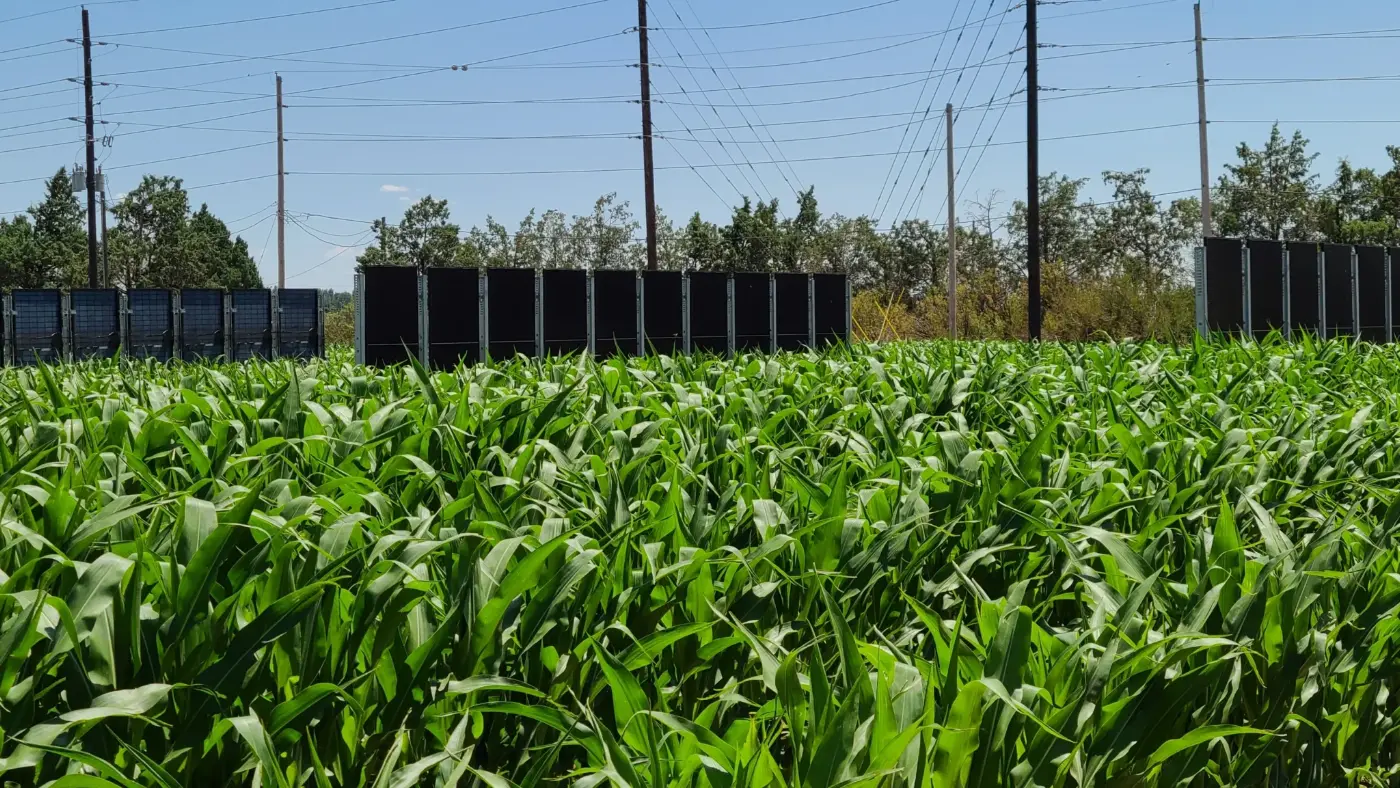
A solution, solar fences. Steering away from traditional solar applications at a fixed tilt, solar fences occupy minimal space—panels are mounted at a fixed 90° angle. These installations are often coupled with bifacial solar panels. Bifacial panels can harvest solar energy from both sides, offering the possibility of increased energy production. With a minimal footprint and the opportunity to experience an increase in energy production, Sandbox Solar began implementing this solution for several projects.
Bifacial Solar Fence Projects
Spring Hill Greens
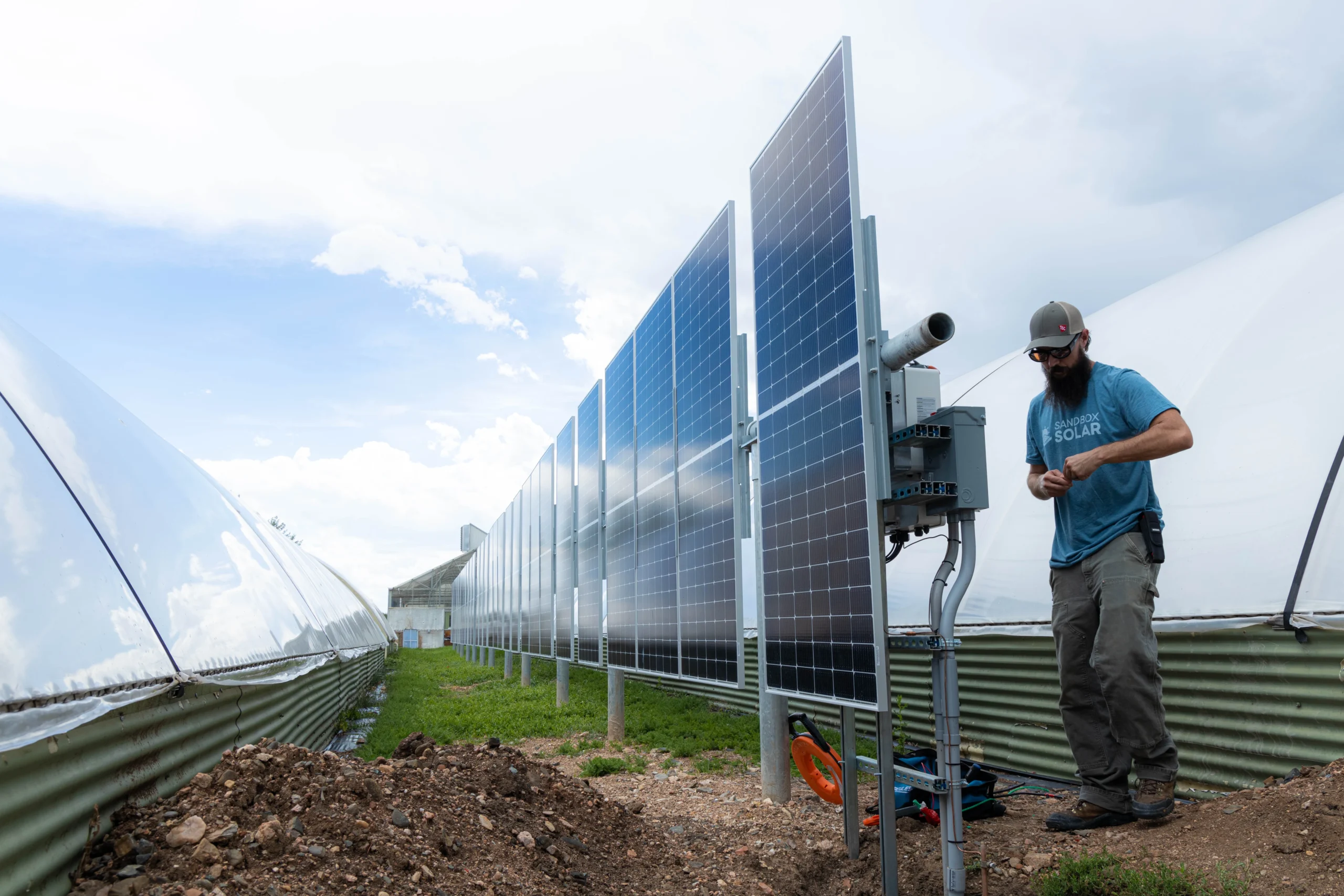
Sandbox Solar was approached by a previous client, Spring Hill Greens, after installing a traditional roof-mounted system. The production of the rooftop system produced sustainable energy efficiently, yet it was not enough to power all operations of this working farm. Striving to be entirely self-sufficient and carbon neutral, they desired more solar. With limited area to dedicate to a traditional ground-mounted system, they knew they could rely on Sandbox Solar to develop a unique solution. Retrofitting an existing Tamarak racking system, two solar fences with 60 bifacial Canadian Solar modules were installed in alleys between hoop houses. This system has been operational since 2022 and is a prime example of agrivoltaics and bifacial solar fences.
Colorado State University Agrivoltaic Testing Grounds
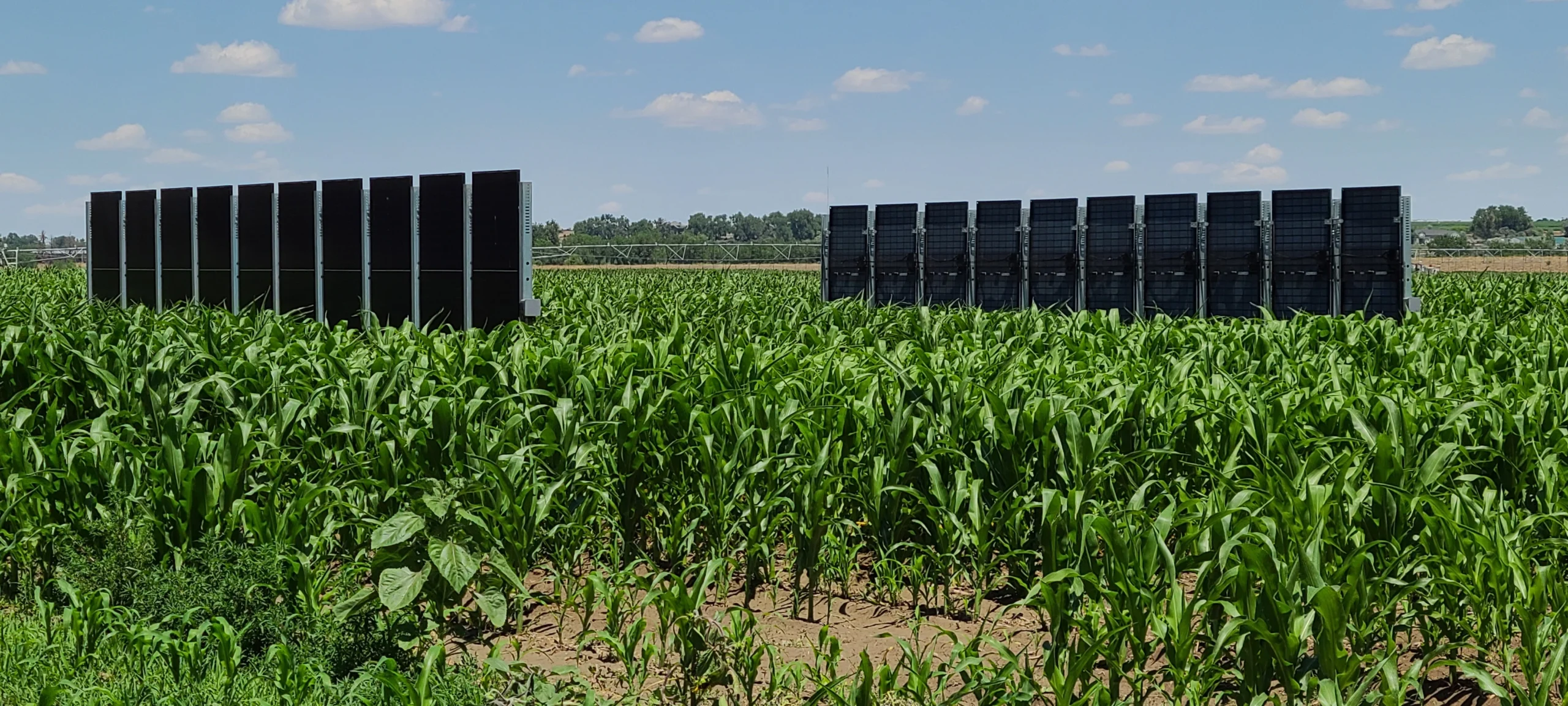
Seeing the success at Spring Hill Greens, Colorado State University was intrigued to implement a similar system at their Agrivoltaic testing grounds. Previously, Sandbox and CSU had collaborated on an agrivoltaic project, evaluating crop and energy production of systems using semi-transparent panel technologies. In response, Sandbox installed 30 bifacial Trina Solar modules attached to Sunzuan’s vertical racking system. In 2024, CSU planted its first crop of corn around this system, demonstrating farming automation and generous crop yield for an agrivoltaic system—a huge advancement for agronomy + agrivoltaics!
Energy Modeling and Efficiency of Bifacial Solar Fences
Seeing the benefit of vertical bifacial solar systems, we had the desire to study the efficiency of these systems and to determine a quality-assured method to predict the energy production of similar systems. With many connections to CSU and new team members at Sandbox Solar, a research project to determine the best methods of modeling energy production for these understudied systems was introduced. Using the System Advisor Model™ (NREL) to evaluate the technology, production, and efficiency of vertical bifacial systems. This study examined production data from the sites at Spring Hill Greens and the Agrivoltaic Testing Grounds at CSU.
Methods
The project started by using the SAM™ application to model energy production of these installed systems; modeling data from input of location, inverter, and module specifications, system design, and shading and layout. Initial attempts yielded results that varied significantly from the historical actual production of these systems. Refined modeling attempts compared actual weather data (obtained from local weather stations) versus TMY (Typical Meteorological Year). Further analysis completed through SolarEdge’s Monitoring service helped input losses due to module mismatch. Additional considerations included alterations to albedo and updated losses (soiling, wiring, diodes, and connections).
Conclusions
Findings from this project illustrated the need to further refine, understand, and compare modeling systems to actual production data. Modeling efforts helped identify higher-than-expected losses of these systems, highlighting the need to explore sources of error and how to eliminate them in future installations. Discussions with international collaborators installing similar systems redirected our attention to focusing on increasing the efficiency of wiring, module orientation, and decreasing shading from the racking infrastructure. This preliminary study opened exploration to increase production and implementation of these systems in the U.S. Sandbox Solar is committed to providing excellence through every step of the design and installation process. This project is not the end of the investigation, and we are currently exploring an in-depth economic analysis of these systems while dedicated to increasing the efficiency of future projects throughout the process.
Glossary
- Agrivoltaics – simultaneous use of land for both agriculture and photovoltaic energy generation. Maximizing land efficiency by allowing crops and renewable energy to coexist.
- Hoop House – a less permanent greenhouse structure utilizing curved poles and plastic sheeting to allow for season extension and crop protection.
- Bifacial Solar Panels (Modules) – solar panels that generate electrical power from both sidesFixed Tilt vs. Vertical Mounting
- Fixed tilt – traditional panel system angled towards the sun, usually between 20° to 60°.
- Vertical Mounting – panels oriented at 90°, saving space and implementing solar in narrow spaces.
- Vertical Bifacial Solar Fence – vertical orientation utilizing bifacial solar panels, offers benefits from a small footprint and increased production from the solar panels.
- SAM™ (System Advisor Model™) – a software tool developed by the National Renewable Energy Laboratory (NREL) to predict the production and viability of renewable energy sources.
- TMY (Typical Meteorological Year) – averaged dataset of weather conditions throughout a year, used in modeling of solar systems and building performance, does not account for actual variations in weather patterns.
- Albedo – a measure of how much sunlight is reflected by a surface.
- Module Mismatch – loss in energy input when solar panels in the same system produce different amounts of energy at the same time.
- Shading Losses – loss in energy input when solar panels experience shading from nearby structures or nearby panels.
- Soiling Losses – loss in energy input when solar panels accumulate debris from dust, disturbed soils, or other forms of airborne particles.