What in the World is a Meter Socket Adapter: Why Would I Want It and Why Can’t I Have It?
Understanding Terminology
First, let’s clear up the terminology. The tech is fairly new, and there hasn’t been a real consensus on what exactly to call it. You’ll see meter collar adapter and meter socket adapter used interchangeably and for the same piece of equipment. The industry is currently leaning toward meter socket adapters, so for the purposes of this blog we’ll be referring to this equipment using that terminology, but using the abbreviation MSA.
What are Meter Socket Adapters?
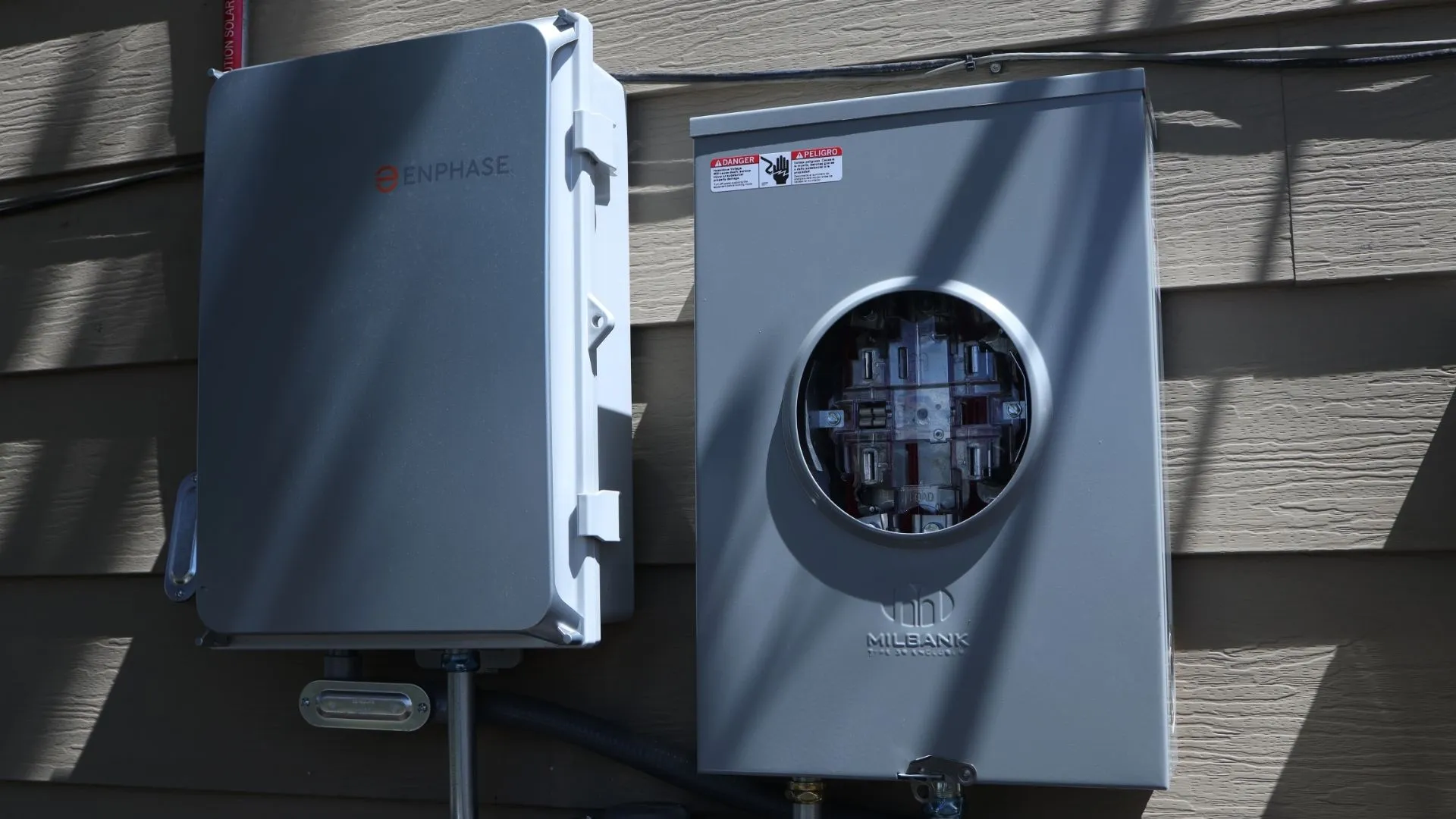
On the most basic level, an MSA is a piece of equipment that gets inserted between your utility meter and the “meter socket” that feeds power to your home. They look like little plastic cylinders that get clamped to the utility meter. An MSA allows the meter to function just as it would without an MSA but offers one of two possible benefits to you and your solar installer.
The first MSAs to come on the market and gain relatively wide use are produced by ConnectDER and allow for solar power to be connected on the utility side of your home’s main breaker. This style of meter socket adapter allows for a larger PV system to be installed than would typically be the case. Here, we need to take a quick aside to talk about some basic electrical components and how the National Electric Code (NEC) helps keep solar safe.
A Look Into Electrical Components
The first basic electrical component we will talk about is your home’s main service panel. This is also called your breaker box, and inside that box, the thing the breakers are connected to is called the busbar. Every busbar has a rating for how much current, in amps, it can safely handle. The most common sizes for busbars are 125A, 150A, 200A, and 225A. The busbar in your main panel is protected from too many amps flowing through it by your main breaker, which generally has a current rating that matches the busbar rating.
Understanding the 120% Rule
The NEC places limits on how much extra current can be placed on the busbar using what is commonly known as the 120% rule. In order to be compliant with this rule, the sum of the main breaker rating and all other power source breakers must be less than or equal to 120% of the busbar rating. So, for a 200A busbar with a 200A main breaker rating, we get a maximum solar breaker rating of 40A (200 x 1.2 = 240A; 240-200A = 40A). Before MSAs were available, there were three main options for getting around the 120% to install a larger PV system.
- A line-side tap, which is essentially splicing in new wires on the meter side of the main breaker. Keep in mind, main panel upgrades are expensive; derating the main breaker means you are lowering the amount of power you can pull from the utility, and a line-side tap is not always possible.
- Derating the main breaker, so changing the math from above to have a 150A main breaker on a 200A busbar (200*1.2 = 240A; 240 – 150a = 90A).
- Upgrading the main panel to have a larger busbar to change the math with a 225A busbar (225*1.2= 270A; 270 – 200 = 70A)
The Two MSA Styles
Why Most MSA’s are Used As MID’s
Impact from Electric Utilities
Given the benefits of this technology, it’s easy to see why the home solar and energy storage industry is excited about it. There is still a major hurdle to overcome before everyone can gain the benefits. That hurdle is the actual electric utilities.
Utilities have wide discretion on what they can allow and disallow on their power grid. Since meter socket adapters are, ideally, installed in the utility meter socket, utilities can choose not to allow their use, and most utilities have chosen that course. Currently, in Sandbox+ Solar’s installation territory, only Xcel Energy and the City of Fort Collins allow MSAs to be installed in the utility meter socket. Every other utility allows for their use, but in a secondary meter housing, which eliminates nearly all the cost benefits of an MSA.
The Hesitation on MSAs in the Industry
- If we have to remove the MSA while servicing the home and the MSA gets damaged, we won’t take responsibility for that.
- Our meter techs are not familiar with this technology, and we are concerned they may be injured or killed while handling unfamiliar equipment.
A Look to the Future
To that point, Colorado State representatives Lesle Smith and Rebeckah Stewart and state senator Cathy Kipp have introduced House Bill 26-1007, which, among other energy-related goals, aims to require utility companies to allow the use of MSAs. The meter socket adapter provision of the bill seems to be the one receiving the most negative feedback from utility companies. This bill has the potential to significantly reduce the cost and increase access to renewable energy for Colorado households.
Meter socket adapters are already reducing the cost of solar and battery storage solutions in Colorado but have the potential to have a much larger impact with greater adoption by electric utilities. They have been tested by third-party laboratories, and most have hundreds to thousands of units already installed and functioning, proving them safe for use. Education surrounding MSAs for utilities and their field employees will hopefully lead to wider adoption, but the industry and customers are getting tired of waiting based on vague concerns, and HB26-1007 may force the issue in favor of consumers.
Start Your Energy Efficient Journey with Us
Although there’s still some work that needs to be done with MSAs in the coming years for greater adaptation, we are still fully committed to helping our local communities in Northern Colorado.